When ownership goes invisible.
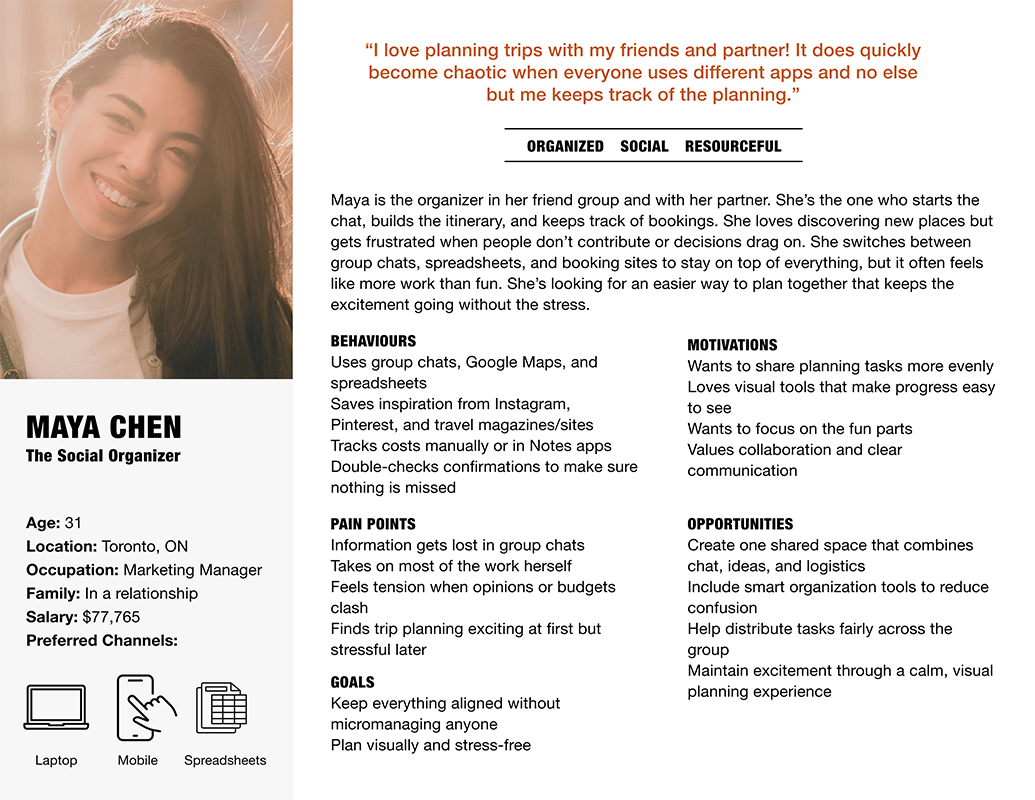
When planning responsibilities are discussed across multiple tools without a shared source of truth, ownership becomes ambiguous and progress difficult to assess. Tasks are acknowledged in chats, tracked informally elsewhere, and rarely revisited in one place.
As a result, groups rely on assumptions. One person compensates by tracking details and following up, while others unintentionally disengage. Over time, this imbalance creates frustration and planning fatigue.
The challenge was to make ownership and progress explicit, so collaboration could feel shared rather than burdensome.
83% of travelers begin researching trips on their phones, with 60% of hotel bookings completed on mobile.
Source: hotelagio.com/travel-booking-statisticsDesign challenge: How might we make task ownership continuously visible so that coordination is shared rather than absorbed by one person?
What the research revealed.
Research with frequent group trip planners showed that coordination issues rarely stem from a lack of willingness to contribute. Instead, responsibility becomes invisible once planning moves primarily into chat-based tools.
Participants described discussing tasks without clearly assigning them, assuming others would take action, and struggling to understand progress without asking for updates. When ownership and progress weren't visible, one person often stepped in to keep planning moving.
This clarified the design direction: shared planning works best when ownership is continuously visible, rather than relying on memory, follow-ups, or additional discussion.
View research insights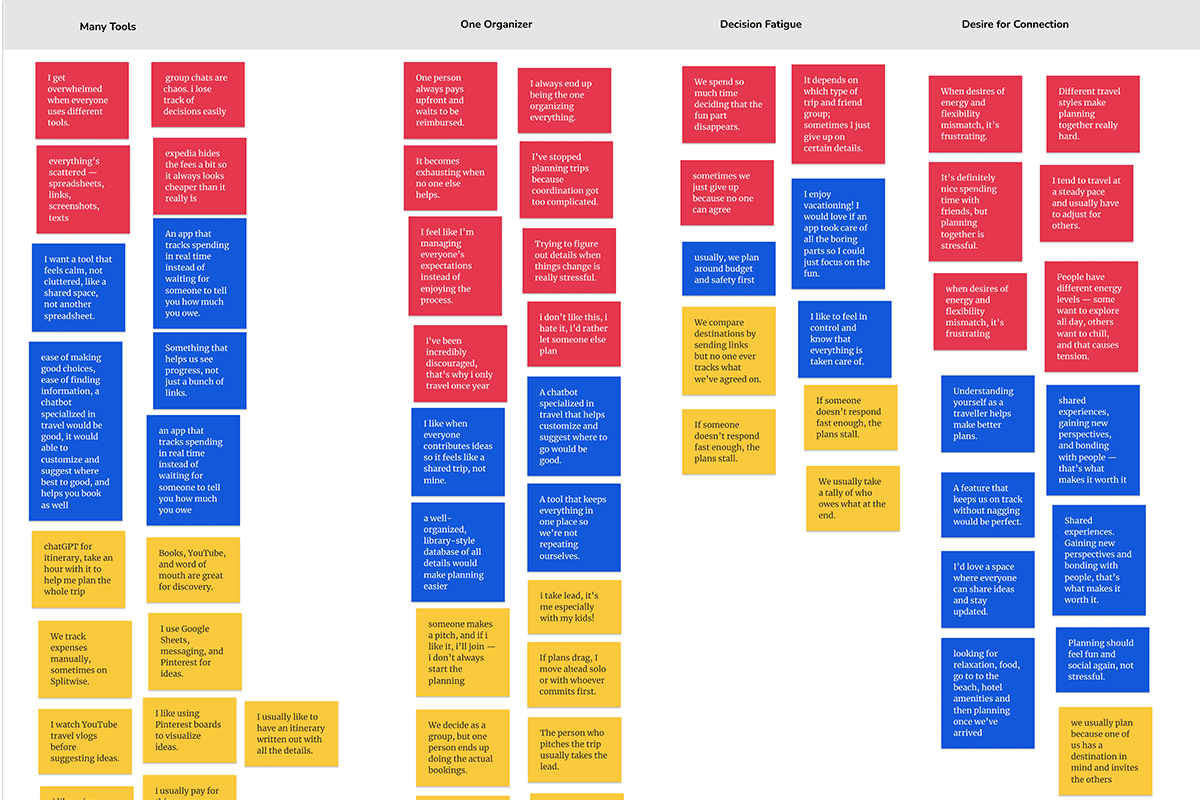
One problem, one clear direction.
The work narrowed to one core problem: making task ownership visible within the coordination flow, where breakdowns had the highest impact.
Tasks became the primary unit of coordination. A single trip dashboard surfaces what needs to be done, who owns it, and its current status — making ownership immediately visible and progress easy to assess. Task creation and assignment are intentionally lightweight, clarifying responsibility without adding planning overhead.
View exploratory sketches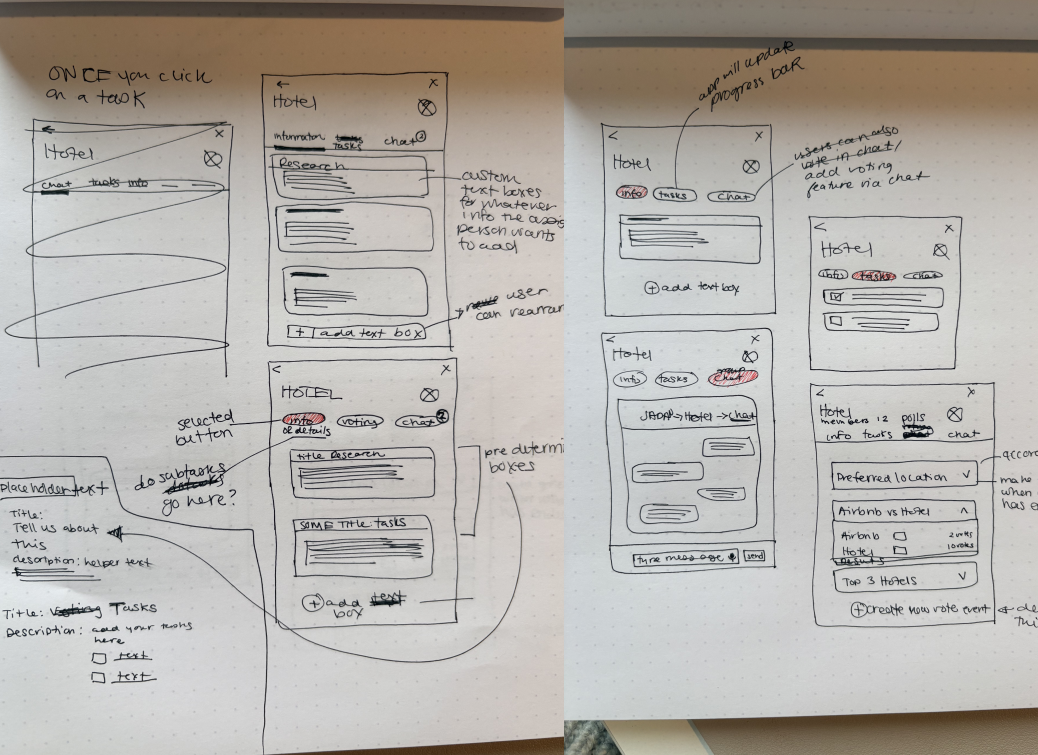
Testing for clarity under pressure.
Usability testing used short, task-based walkthroughs to observe how participants interpreted ownership and progress without guidance. Testing focused on three flows: viewing the trip overview, assigning tasks, and checking progress.
Participants consistently understood who was responsible for what. Moments of hesitation revealed where clarity broke down — particularly when labels or icons required interpretation rather than recognition.
These findings informed a focused round of refinement, including clearer labels, stronger visual hierarchy, and simplified icon usage. After iteration, key actions required less explanation and hesitation during coordination moments was reduced.
View low-fidelity prototypeOwnership, made visible.
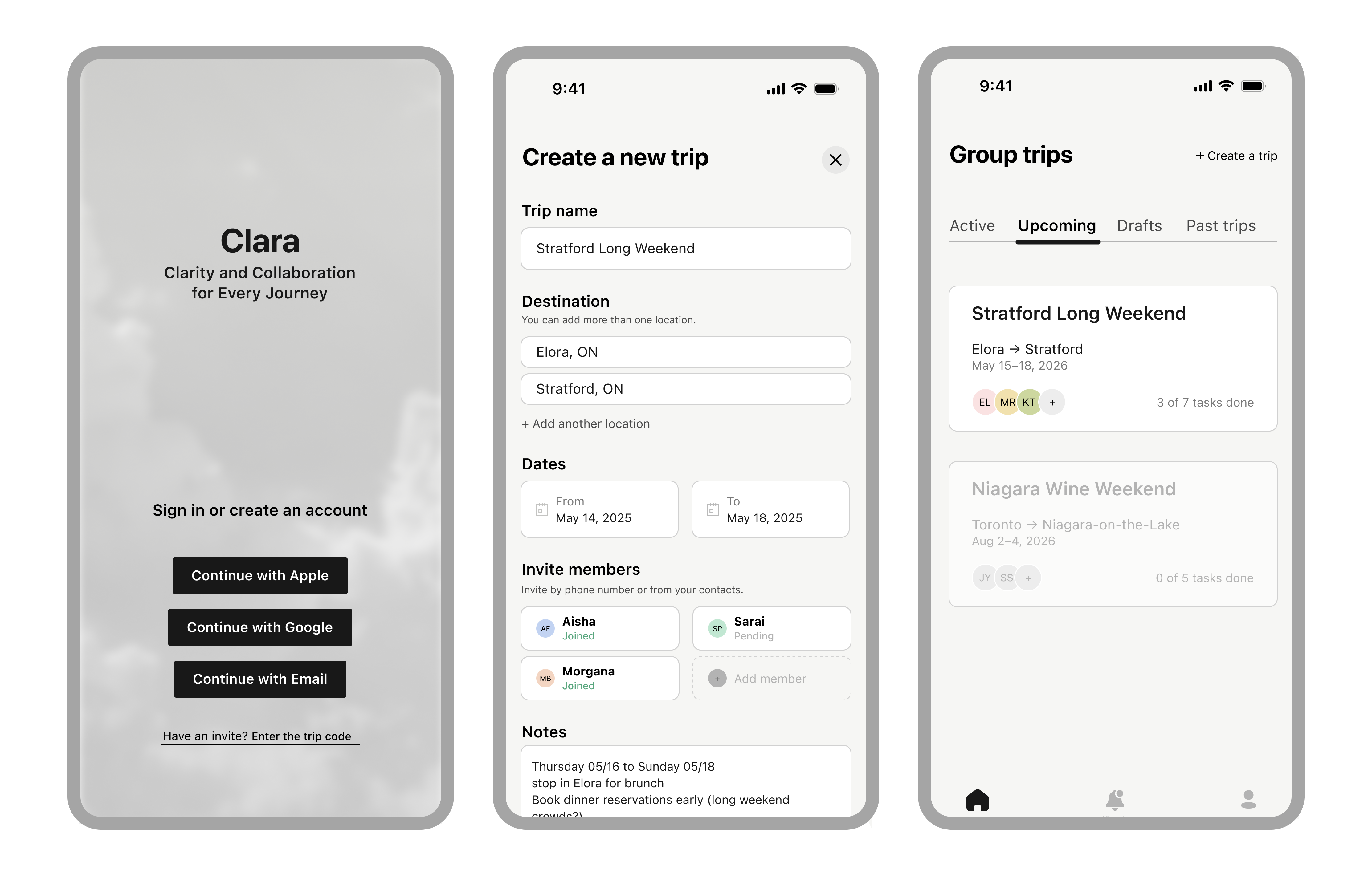
The Create a New Trip screen gives users a simple way to set details, invite friends, and start planning with clarity. From there, the trip dashboard keeps the whole group aligned — surfacing who owns what, and where things stand, at a glance.
What Clara taught me.
By centering the experience on explicit task ownership and visible progress, Clara reduces ambiguity during group trip planning. Responsibilities are clear, progress is easy to assess, and coordination no longer depends on recalling past conversations or inferring ownership.
- One strong insight can guide an entire product
- Microcopy is a critical UX tool
- Clarity often matters more than feature depth
Where Clara goes next.
With the core coordination flow established, future iterations could explore: