A heuristic evaluation and targeted redesign of the lululemon iOS app, identifying where movement content gets buried, and designing a clearer path to it.
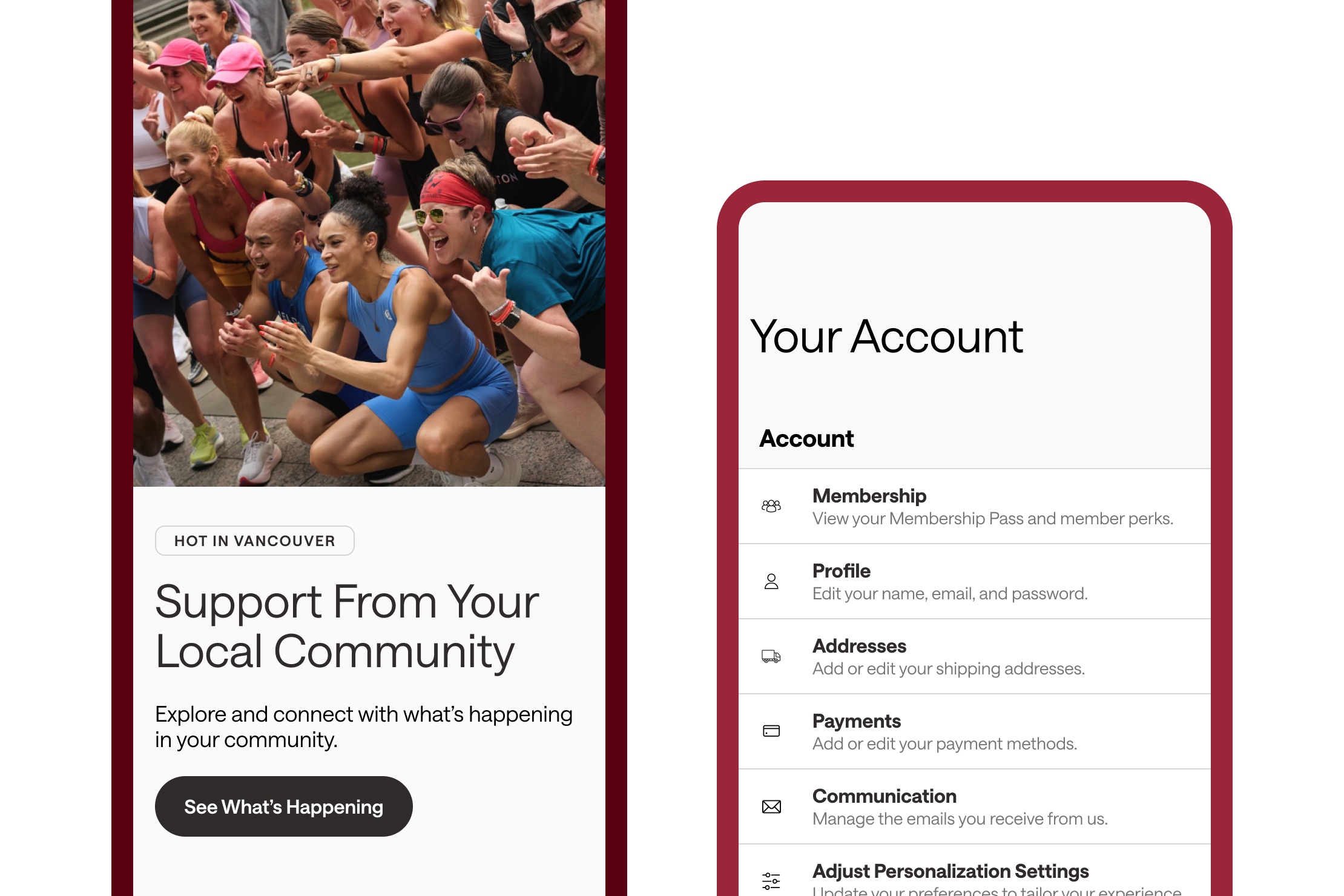
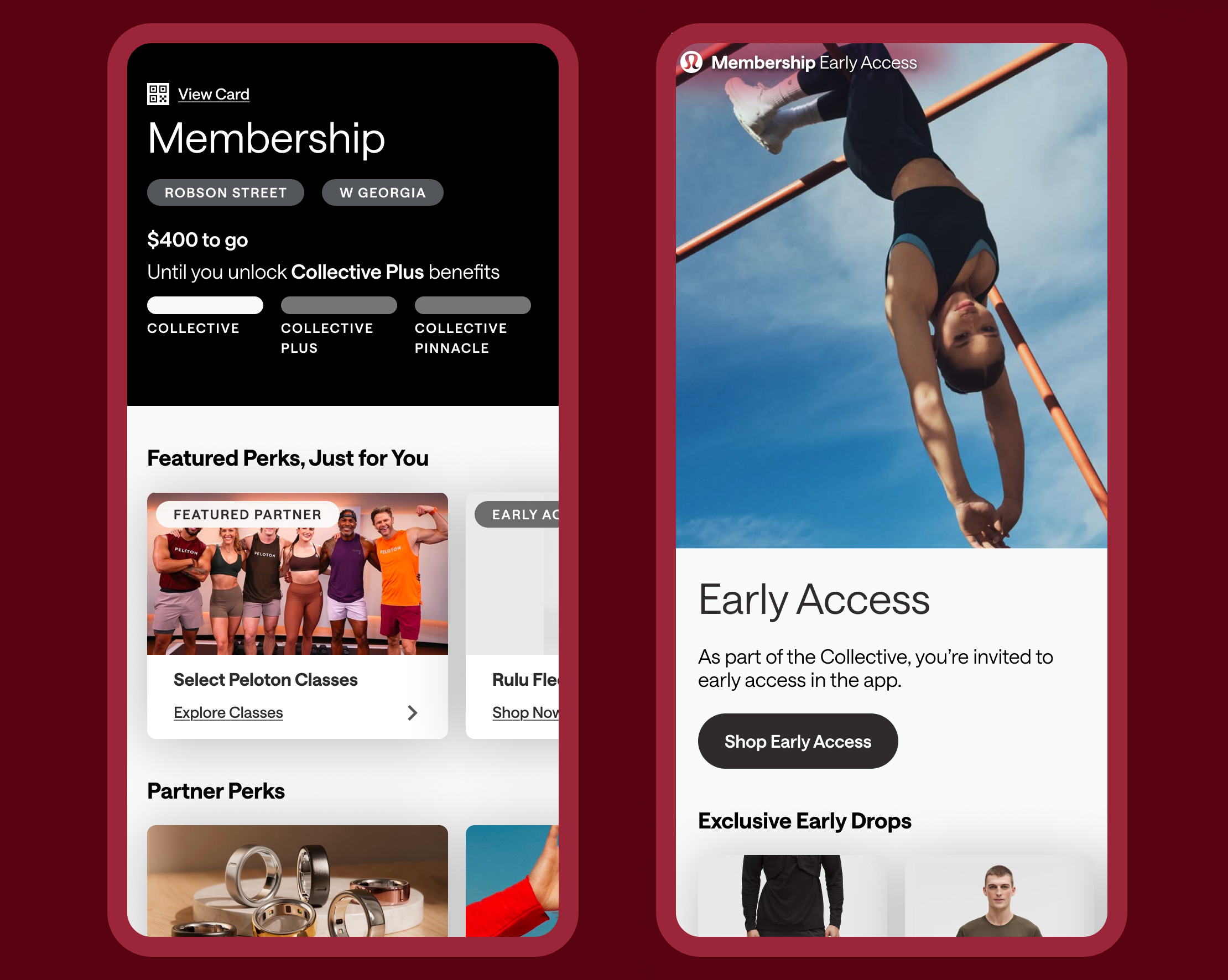
lululemon has built a genuinely valuable movement ecosystem, online classes, community events, local instructor-led sessions. The app has the content. The problem is that it's hidden behind membership screens, partner-perk pages, and navigation paths that don't reflect how movement-focused users actually think about the app.
New or returning movement users arrive expecting to find classes. Instead they encounter a home screen that doesn't signal movement content exists, cards that look interactive but aren't, and multiple dead ends with no clear next step. The experience creates confusion and erodes exactly the confidence lululemon's community positioning is designed to build.
Design challenge: How might we redesign the navigation and content hierarchy so that movement-focused users can find, start, and complete a class without hitting a dead end?
What lululemon has
A rich movement ecosystem: online classes, community events, partner content, local sessions.
What users experience
An interface that hides the movement content behind membership layers users weren't expecting to navigate.
Our team audited the full journey, from home screen to class completion, using Nielsen's heuristics and a 0–4 severity scale. The most significant findings shared one pattern: the interface set expectations it didn't fulfill, then left users with nowhere to go.
| Finding | Heuristic violated | Screen | Severity |
|---|---|---|---|
| Movement classes are invisible from the home screen | #7 Flexibility + Efficiency of Use | Home | Level 3 |
| Home screen doesn't signal that classes exist | #2 Match between system and real world | Home | Level 3 |
| Members-Only Experiences page is a dead end — no next steps | #7 Flexibility + Efficiency of Use | Members | Level 3 |
| Featured Partner card implies a full class range; only yoga is available | #2 Match between system and real world | Members | Level 3 |
| "Good Afternoon" looks like a static header but functions as a button | #4 Consistency and standards | Home | Level 2 |
| Top Benefits cards look interactive but are static | #4 Consistency and standards | Members | Level 2 |
| No "class complete" state — the flow ends without acknowledgement | #2 Match between system and real world | Class player | Level 2 |
Within the team's sprint, I owned the Class Detail page and the Class Completion state, the two screens that sit at the sharpest point of the user's movement journey. One is where the decision to start is made. The other is where the experience closes. Both were failing the user in different ways.
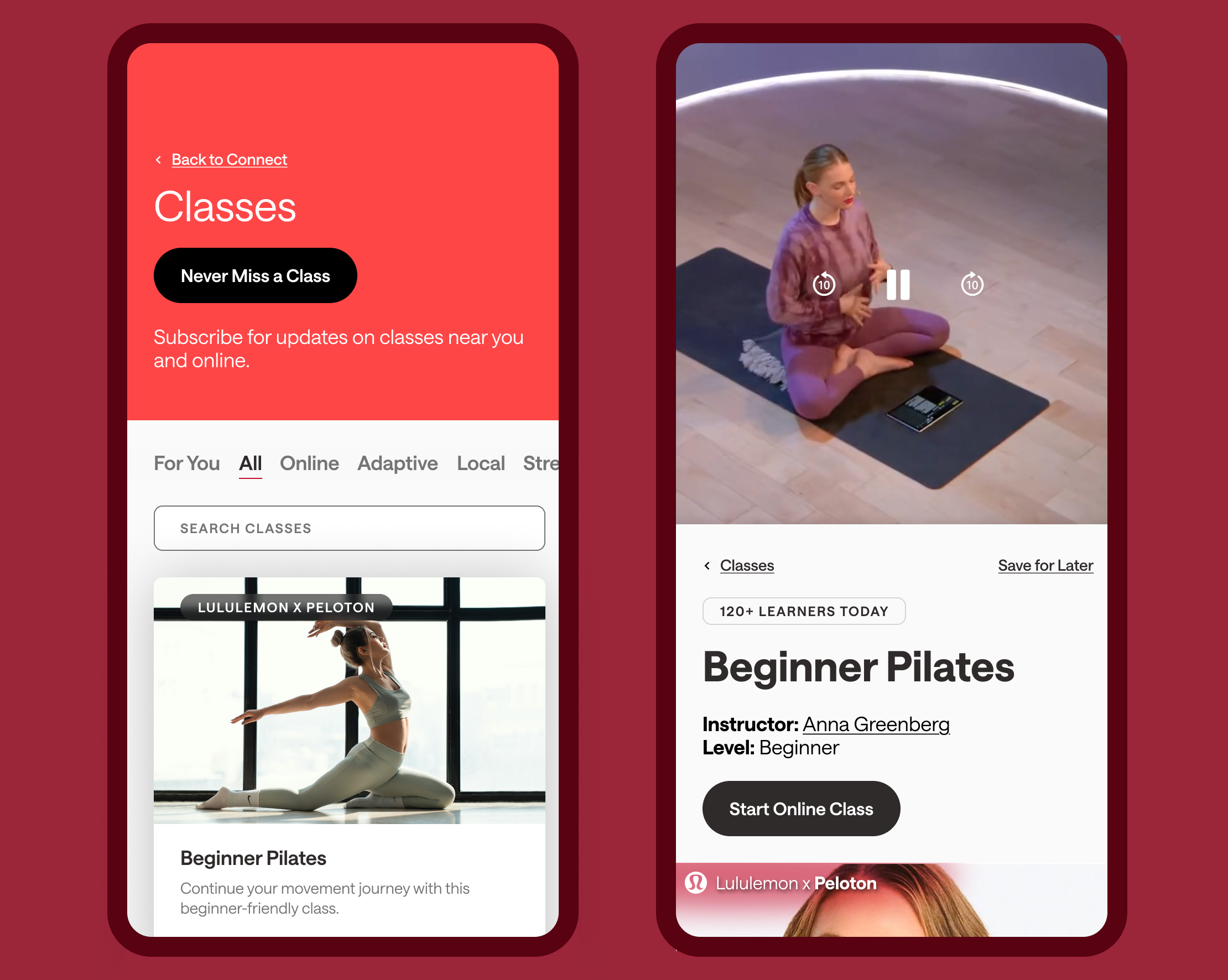
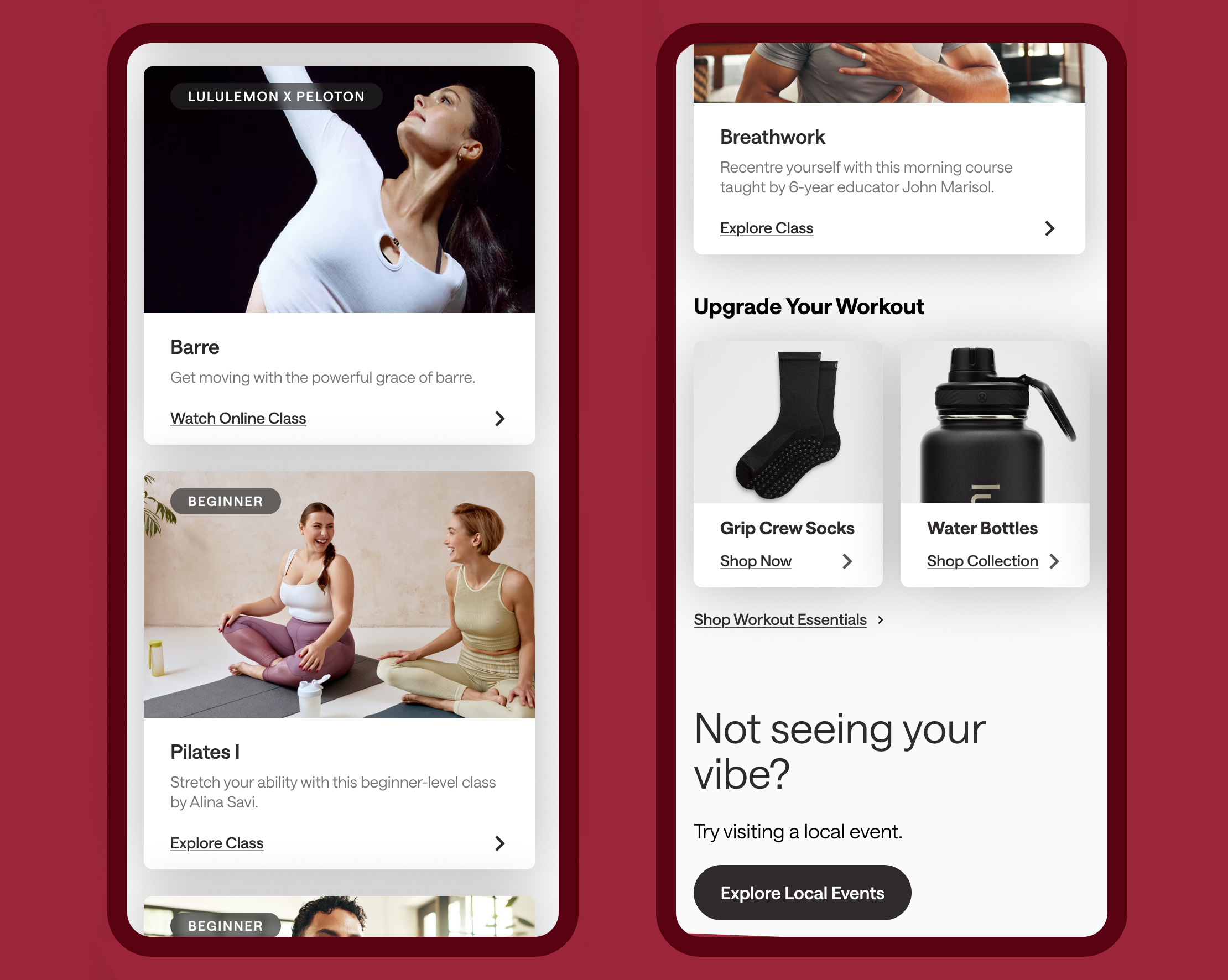
The original layout buried the start action beneath product cards and instructor details. A user ready to begin had to scroll past the shop to find the entry point.
The redesign moves instructor context and the start action to the top, product recommendations appear after the class, when they're actually relevant.
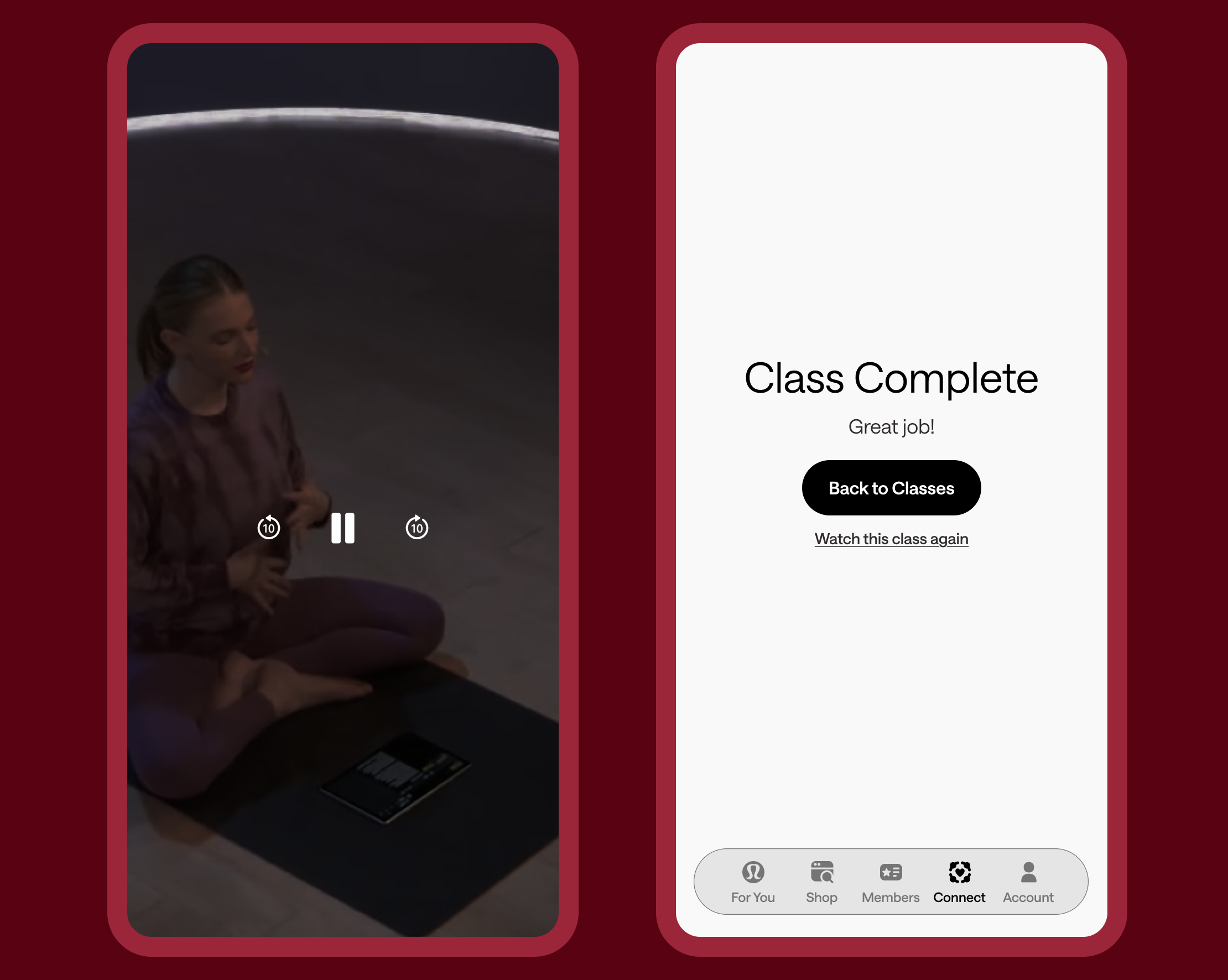
The existing flow ended without acknowledgement. Users were returned to the class player as if nothing had happened, no confirmation, no closure, no next step.
Every movement app users have a reference point for — Peloton, Nike Training Club, Apple Fitness+ — marks completion with a dedicated moment. lululemon's absence of this state violated a basic user expectation and left the experience feeling unfinished. The redesign adds a clean completion screen: "Class Complete · Great job!" with two clear paths forward — back to classes, or watch again.
Our team's redesign addressed three goals from the prioritization matrix: make classes easy to find, help users choose with confidence, and eliminate dead ends across the movement journey.
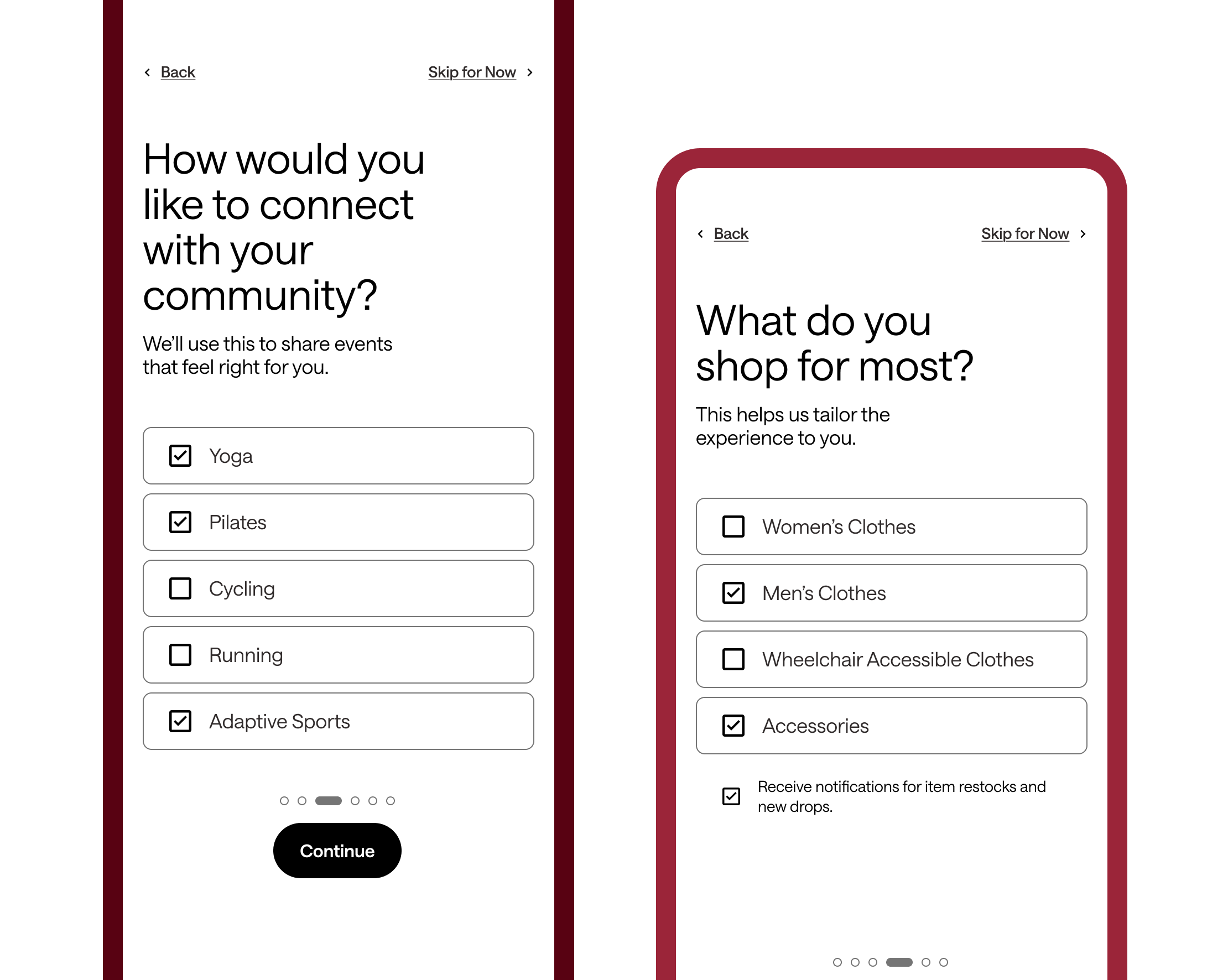
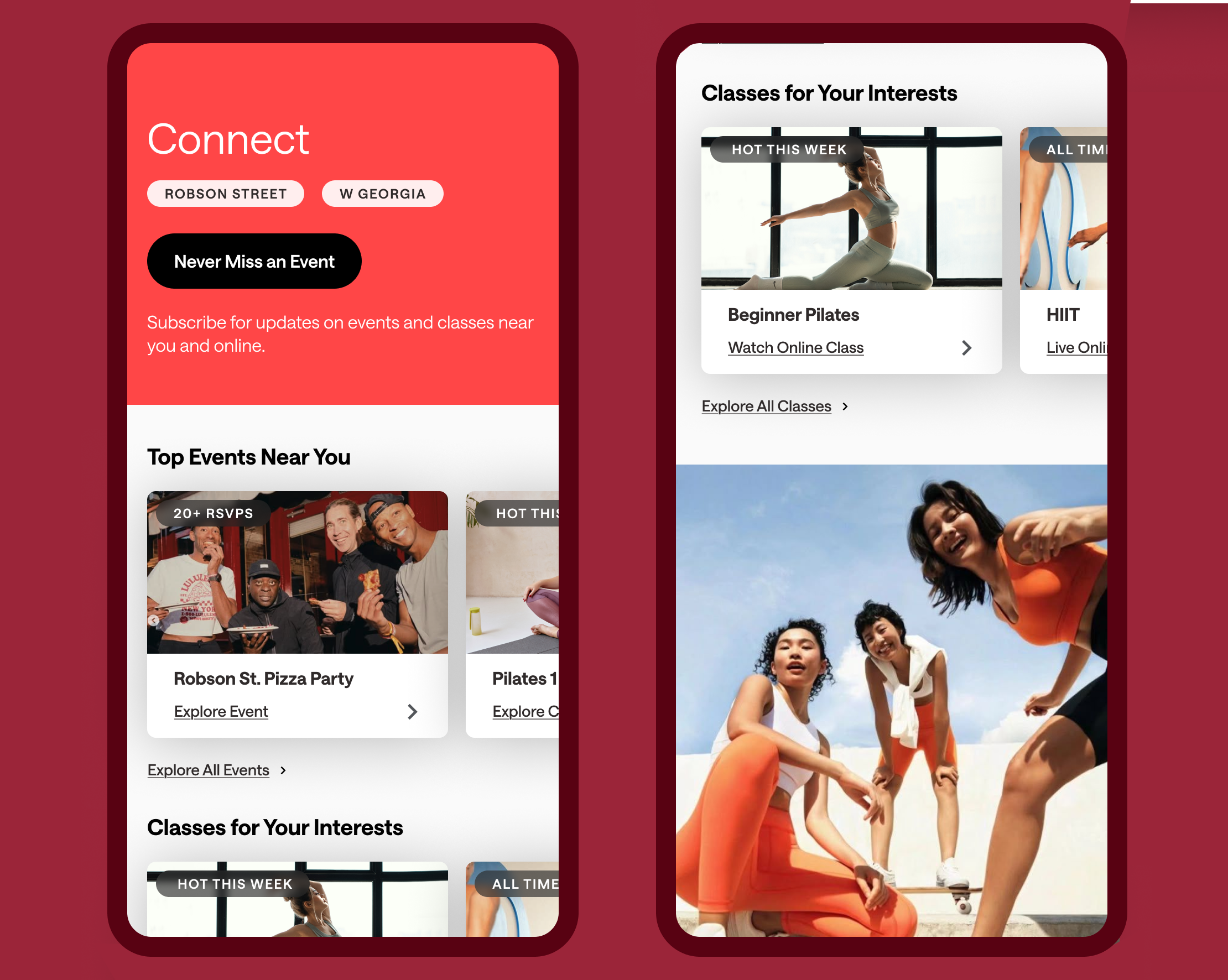
The For You screen was restructured so movement content appears immediately (alongside product recommendations) rather than hidden behind separate navigation. Community events were given equal visual weight. Interactive elements were made consistently responsive. Dead ends were replaced with clear next steps.
A high-fidelity redesign across five screens, presented to lululemon stakeholders in December 2025.
Each change was tied to a specific heuristic issue and severity rating. The work reframed a central gap: the platform holds strong content, but the interface obscures it.
The sharpest finding from the evaluation, that excellent content was being actively hidden by the interface, translated directly into the design strategy and its business case: a user who can find and complete a class is more likely to return, engage with the community, and convert on product recommendations than one who never found the class at all.
What this sprint made concrete is something easy to say in theory: every heuristic violation is a broken promise. The lululemon app wasn't poorly designed, it was well-designed for a version of itself that didn't prioritize movement. The confusion wasn't random. It was the predictable result of a content strategy and an interface that had quietly diverged.
Working on the Class Detail and Completion screens reinforced a simple principle: once a user has decided to act, the interface should step aside. The role of the system is to support that decision, not compete with it.
If the project continued, the next layer would include: